 Police Scanner
Listen to live police, fire, and EMS radio
Thousands of live public-safety audio feeds from every US state, county, and major city — streamed to your iPhone, HomePod, or Apple TV.
Download free on the App StoreFree · iOS 14 and later · No account required
What you get
Nationwide coverage
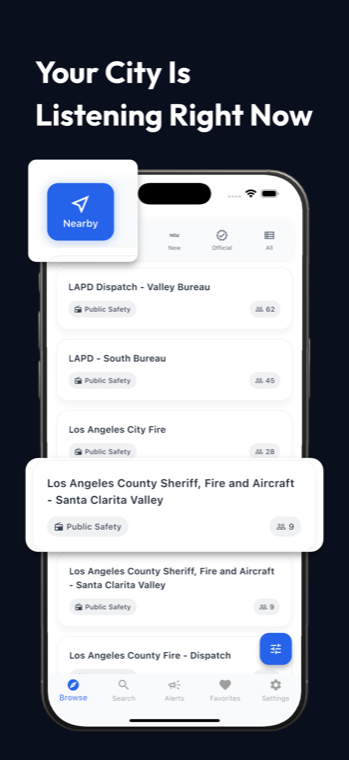
Browse by state, county, and city — from NYPD and LAPD dispatch down to rural sheriff and volunteer fire departments.
AirPlay built in
Send live scanner audio to a HomePod, Apple TV, or any AirPlay speaker and listen through the whole house.
Keeps playing
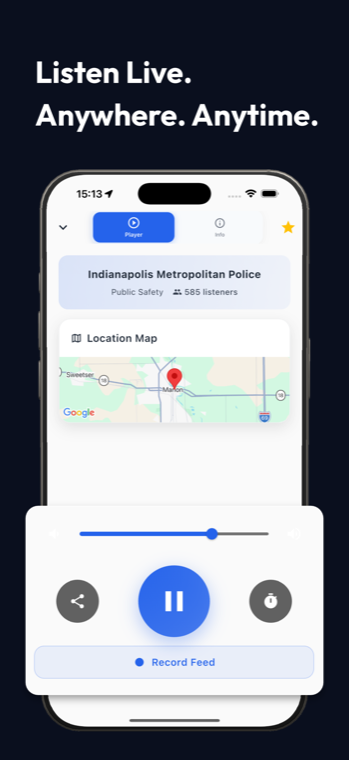
Audio continues while you use other apps or lock the screen, with full lock-screen controls.
Live alerts
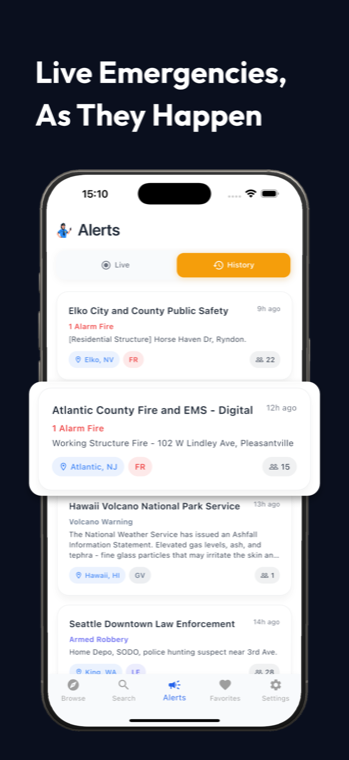
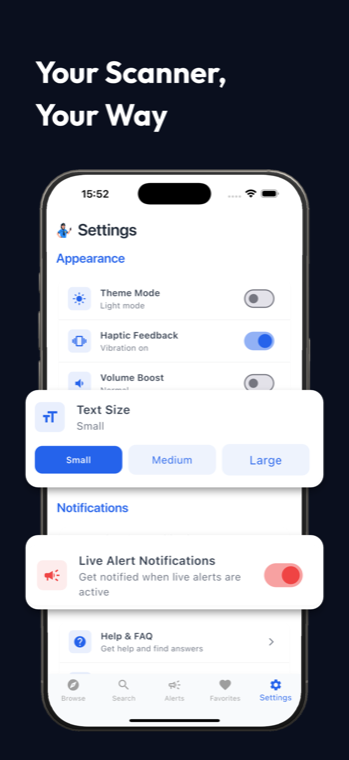
Opt in to a push notification when a feed is flagged for a major incident, so you know to tune in.
Favorites
Save the channels you actually follow and reopen them in one tap.
Record what matters
Capture a segment of live audio to your device and share it.
How scanner feeds work
Public-safety agencies across the United States broadcast dispatch traffic over radio systems that are, in most cases, open to the public. Volunteers run receivers that pick up those transmissions and stream them online. The app indexes those streams, organises them by location, and plays them back — no radio hardware, no antenna, and no subscription needed to start listening.
That also explains the two things new listeners notice first: audio runs a few seconds behind real time, and quiet stretches are normal. A busy city channel talks almost continuously; a rural county at 3am genuinely does not.
Not an emergency service. Scanner audio can be delayed, incomplete, or unavailable, and many agencies encrypt some or all channels. Never rely on it in an emergency — call 911.
Find feeds where you live
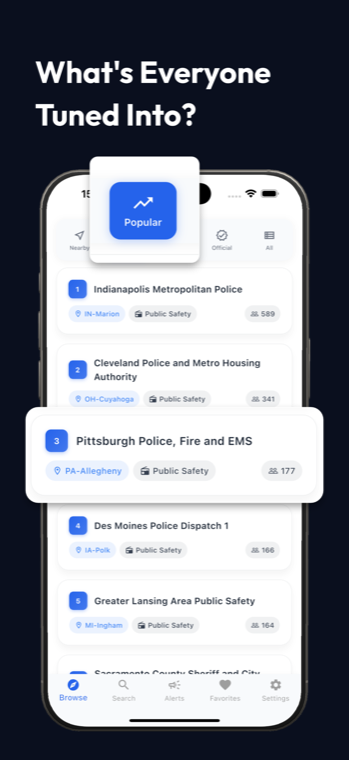
Every US state, broken down by county, with the feeds each one carries and how many people are listening right now.
Browse scanner feeds by state →
Common questions
Is it legal to listen to a police scanner?
Yes. Federal law permits receiving unencrypted radio, and no US state bans scanner listening outright. A few states restrict using one in a vehicle, and every state punishes using a scanner to assist or evade a crime. Read more →
Do I need a subscription?
No. The app is free to download and you can listen without an account. A premium tier removes listening limits and adds extras, but the feeds themselves are free.
Why can I not find my local police department?
Many agencies have encrypted their radio systems, which removes them from public listening entirely — no scanner or app can receive encrypted traffic. Fire and EMS dispatch usually remain open in the same area. Read more →
Does my iPhone pick up radio directly?
No. iPhones have no public-safety radio receiver. The app plays internet audio streams relayed by volunteers who run receivers near the agencies they cover. Read more →
Can I listen with the screen off?
Yes. Audio continues while you use other apps or lock the screen, with lock-screen controls, and can be sent to a HomePod, Apple TV, or any AirPlay speaker.
Why is a feed silent?
Usually because the radio traffic is genuinely quiet — dispatch is bursty and a rural county can go many minutes without a transmission. A feed can also be offline if the volunteer running it has lost power or internet. Read more →
Guides and reference
Plain-English explanations of how scanning actually works — what the codes mean, what the law says, and why some channels have gone quiet.
- Is It Legal to Listen to a Police Scanner?
Listening to unencrypted police radio is legal across the United States, but a handful of states restrict scanners in vehicles and every state punishes using one to aid a crime.
- Police Radio Codes Explained — Ten-Codes, Signals, and Plain Speech
What 10-4, 10-20, Code 3, and Signal 7 actually mean, why the same code means different things in different cities, and why many agencies dropped codes entirely.
- Why Are Police Channels Encrypted? What Changed and What You Can Still Hear
Why departments across the US have encrypted their radio traffic, which agencies still broadcast in the clear, and what remains available to scanner listeners.
- What Is a Trunked Radio System? P25, Talkgroups, and Digital Scanning
How trunked radio differs from conventional channels, what P25 Phase I and Phase II mean, and why talkgroups replaced frequencies as the thing you tune to.
- How to Listen to a Police Scanner on iPhone
You do not need scanner hardware to hear live police, fire, and EMS radio on an iPhone. Here is how online feeds work, how to find yours, and how to listen in the background or over AirPlay.
- Why Is My Scanner Feed Offline, Silent, or Delayed?
Feeds go quiet for a handful of predictable reasons — a volunteer's receiver, agency encryption, genuinely quiet radio traffic, or buffering. How to tell which one you have hit.